February 9, 2026
What Are the First Signs of Radon Exposure? What Ottawa Homeowners Need to Know
What are the first signs of radon exposure? The honest answer may surprise you — and it’s exactly why Ottawa homeowners need to act before symptoms appear.
Radon gas is one of the most dangerous things in your home — and yet it gives you no warning before it does serious harm. If you’ve been searching for the first signs of radon exposure, hoping for a list of symptoms to watch for, the answer is both important and sobering. There are no early warning signs. By the time radon causes noticeable harm, the damage has been building for years.
This article explains exactly how radon affects your health, why Ottawa homeowners can’t rely on symptoms as a warning system, and what you should do instead.
The Uncomfortable Truth: Radon Has No Early Symptoms
Radon is a tasteless, odourless, and invisible radioactive gas. Unlike carbon monoxide — which causes headaches, dizziness, and nausea at high concentrations — radon produces no immediate physical reaction, no matter how high the levels in your home.
You cannot smell radon. You cannot feel it. You will not develop a cough, a rash, or any other short-term symptom that alerts you to its presence. Because radon damages cells through cumulative radiation — not through chemical irritation — the body has no acute response to it, even at elevated concentrations.
This is what makes radon so serious: the first sign of radon exposure is often a lung cancer diagnosis, years or even decades after the exposure began.
How Radon Damages Your Lungs Over Time
To understand why radon causes no early symptoms, it helps to understand what it actually does inside your body.
When you breathe air containing radon, the gas enters your lungs. Radon naturally breaks down into radioactive particles, and these particles can become trapped in the lung tissue. Over time, the radiation emitted by these particles damages the cells that line your lungs. This cellular damage, accumulated over many years of repeated exposure, is what can eventually develop into lung cancer.
According to Ottawa Public Health, the health risks from radon exposure depend on three factors:
- The level of radon in your home — higher concentrations mean more radioactive particles are being inhaled
- The length of time you are exposed — radon’s effects are cumulative; the longer the exposure, the greater the risk
- Your smoking habits — smokers exposed to elevated radon face a significantly higher risk than non-smokersThis cumulative model explains why symptoms don’t appear right away. Your lungs are not acutely irritated — they are being exposed to a slow, invisible process that takes years to manifest as illness.
The One Confirmed Health Effect: Lung Cancer
Lung cancer is the only confirmed health outcome linked to radon exposure. No other illness — not respiratory infections, not headaches, not fatigue — has been established as a direct result of radon in the scientific literature.
The International Agency for Research on Cancer (IARC) classifies radon as a known cause of cancer. In Canada, the numbers are striking:
- Health Canada estimates that approximately 16% of lung cancer deaths in Canada are related to radon exposure in the home
- It is estimated that more than 3,000 Canadians die from radon-related lung cancer each yearDifferent health authorities around the world have established action levels — the concentration at which they recommend homeowners take action. Canada’s guideline of 200 Bq/m³ sits at the higher end of the international range:
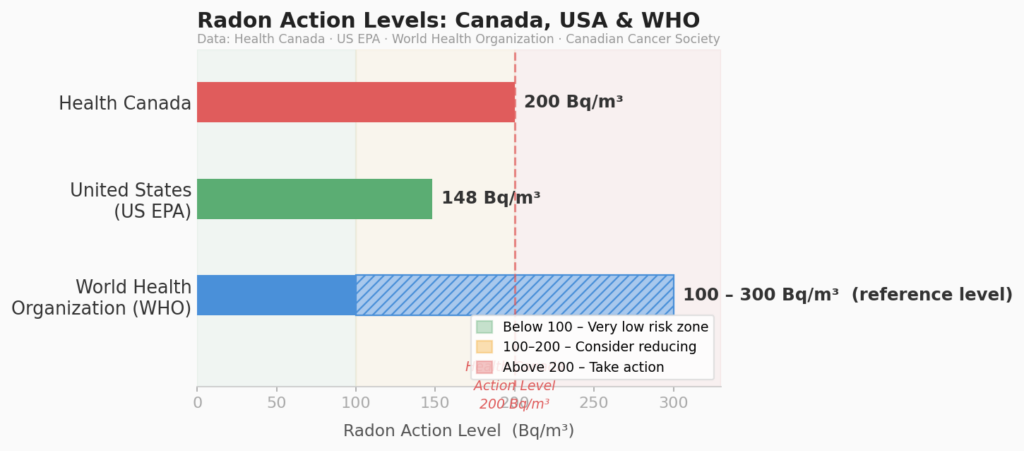
Radon is also the leading risk factor for lung cancer among people who have never smoked. For non-smokers, radon represents by far the most significant environmental lung cancer risk they face at home.For smokers, the combined risk is even greater. Breathing in radon while also smoking creates a compounding effect on lung cancer risk that is significantly higher than either factor alone.
Why Ottawa Homeowners Face a Particular Risk
Ottawa’s geology and climate create conditions where radon is a real and present concern — not an abstract national statistic.
Radon concentrations vary considerably across the city, driven by the uranium content in the underlying rock and soil. Ottawa Public Health notes that radon levels vary a great deal not just across Canada, but within the City of Ottawa itself, making it difficult to predict any home’s radon level without testing.
Ottawa’s cold climate adds another layer of risk. During the long heating season, windows and doors stay sealed for months at a time. This airtight environment allows radon — which continuously seeps up from the soil beneath your foundation — to accumulate to higher indoor concentrations than it would in a better-ventilated building.
Homes that have been made more energy-efficient and airtight, without ensuring sufficient fresh air supply, can be at particular risk.
You Cannot Wait for Symptoms — Testing Is the Only Answer
Because there are no first signs of radon exposure to watch for, testing is the only reliable way to know whether you are at risk.
A long-term radon test, placed in the lowest livable area of your home for a minimum of 91 days, gives you an accurate picture of the radon concentration your household is actually breathing. Health Canada recommends testing every home.
If your results come back above Health Canada’s guideline of 200 Bq/m³, Ottawa Public Health advises taking action:
| Radon Level | Recommended Action Timeline |
|---|---|
| Greater than 600 Bq/m³ | Remediate within one year |
| 200–600 Bq/m³ | Remediate within two years |
Even at levels below 200 Bq/m³, the Canadian Cancer Society recommends reducing radon to as low as reasonably achievable — because there is no level of radon exposure that is entirely without risk.
The good news is that high radon levels are fixable. Active Soil Depressurization (ASD) is the primary mitigation method — after a properly installed system is running, many homes achieve radon levels comparable to outdoor air. Most homes can be mitigated within a single day.
FAQ
Q: What are the first signs of radon exposure in humans? A: There are no early warning signs. Radon causes no immediate symptoms — no headaches, no cough, no dizziness. The only confirmed health effect of long-term radon exposure is lung cancer, which may develop years after the exposure began. The only way to know if you are being exposed is to test your home.
Q: Can radon make you feel sick right away? A: No. Radon does not cause any acute or short-term illness, even at high indoor concentrations. It works through cumulative radiation damage to lung cells over many years. If you are feeling sick, radon is not the cause of any immediate symptoms.
Q: Is radon a problem in Ottawa homes specifically? A: Yes. Ottawa Public Health confirms that radon levels vary significantly across the city, and the cold climate means homes stay sealed for long periods, allowing radon to accumulate. Testing is the only way to know your home’s actual level.
Q: Who is most at risk from radon exposure? A: Everyone who breathes elevated radon levels is at risk, but certain groups face greater danger: people who spend more time in lower floors (where radon concentrates), long-term residents of untested homes, and especially smokers — whose lung cancer risk from radon is compounded significantly compared to non-smokers.
Q: If I’ve lived in my home for years without getting sick, does that mean my radon is safe? A: Not necessarily. Radon causes no symptoms even during prolonged exposure. Many people with elevated radon have lived in their homes for years without any awareness of the risk. The only way to confirm your home is safe is to test it.
Protect Your Family Before Symptoms Appear
Since there are no first signs of radon exposure to warn you, testing is the most important step you can take for your family’s health. Ottawa Radon Expert is a trusted local team with extensive experience assessing and mitigating radon in Ottawa homes. We provide professional testing, complete mitigation solutions, and a post-mitigation warranty so you can have confidence in your results — and your air.
Contact Ottawa Radon Expert today to find out what’s actually in your home’s air.
Sources
- Radon — Canadian Cancer Society
- Radon — Health Canada
- What is Radon? — Canadian National Radon Proficiency Program (C-NRPP)
- CAN/CGSB-149.12-2024 — Radon Mitigation in Existing Buildings — Canadian General Standards Board, September 2024