August 13, 2025
What Is Radon Gas — and Why Should Ottawa Homeowners Care?
What is radon gas, and why should Ottawa homeowners care? Learn how radon forms, how it enters your home, the lung cancer risk, and what to do about it.
Radon is a radioactive gas you cannot see, smell, or taste — and it may be accumulating in your home right now without any sign that it’s there. Health Canada estimates that radon causes more than 3,000 lung cancer deaths in Canada every year, making it the leading cause of lung cancer among people who have never smoked. Approximately 1 in 6 homes in the Ottawa-Gatineau area exceed Health Canada’s guideline for safe indoor radon levels. This article explains what radon is, how it gets into Ottawa homes, what the health risk actually means, and what you can do about it.
What Is Radon?
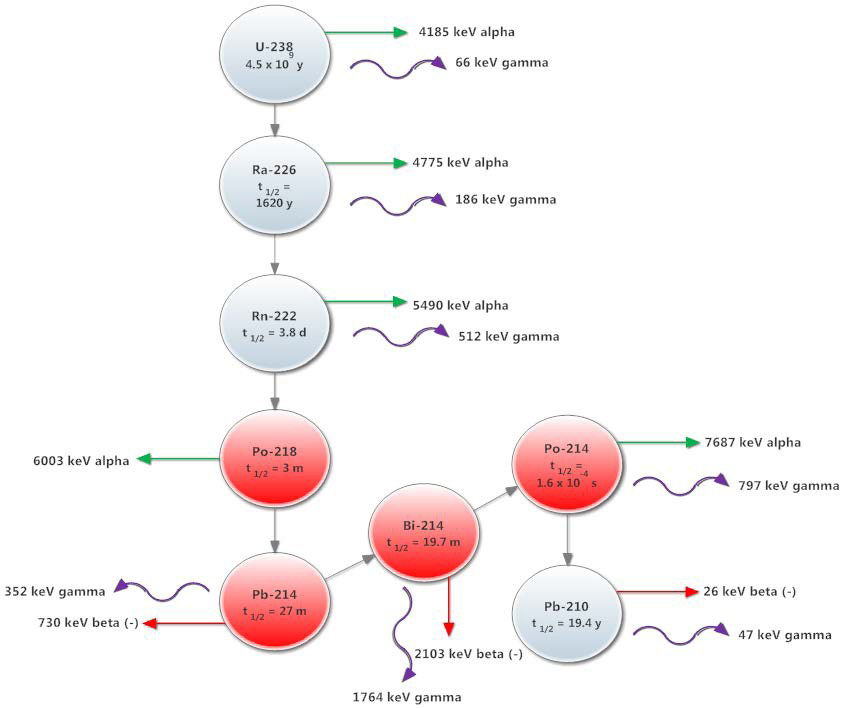
Radon is a naturally occurring radioactive gas formed during the breakdown of uranium in soil and rock. It has no colour, odour, or taste — there is no physical sensation that indicates its presence.
The process begins deep in the earth. Uranium is present in varying concentrations in the rock and soil beneath virtually every building in Canada. As uranium decays, it produces radium, which in turn breaks down into radon gas. Radon is released from the soil and, because it is a gas, it migrates upward through the ground and into the air.
Outdoors, this is not a problem. Radon disperses rapidly in the open atmosphere and typically reaches only 5 to 15 Bq/m³ in outdoor air — concentrations too low to pose a health risk. The problem arises when radon enters an enclosed space and accumulates.
How Does Radon Enter Your Home?
Every building in contact with the ground has radon entering it. The question is how much.
Radon moves through soil and enters buildings through any gap or opening in the foundation:
- Cracks in concrete foundation walls and floor slabs
- Gaps around pipes, utility penetrations, and wiring
- Floor-to-wall joints in the basement
- Sump pump openings and drainage systems
- Dirt floor crawl spaces
- Well water (radon can be released from water during household use)
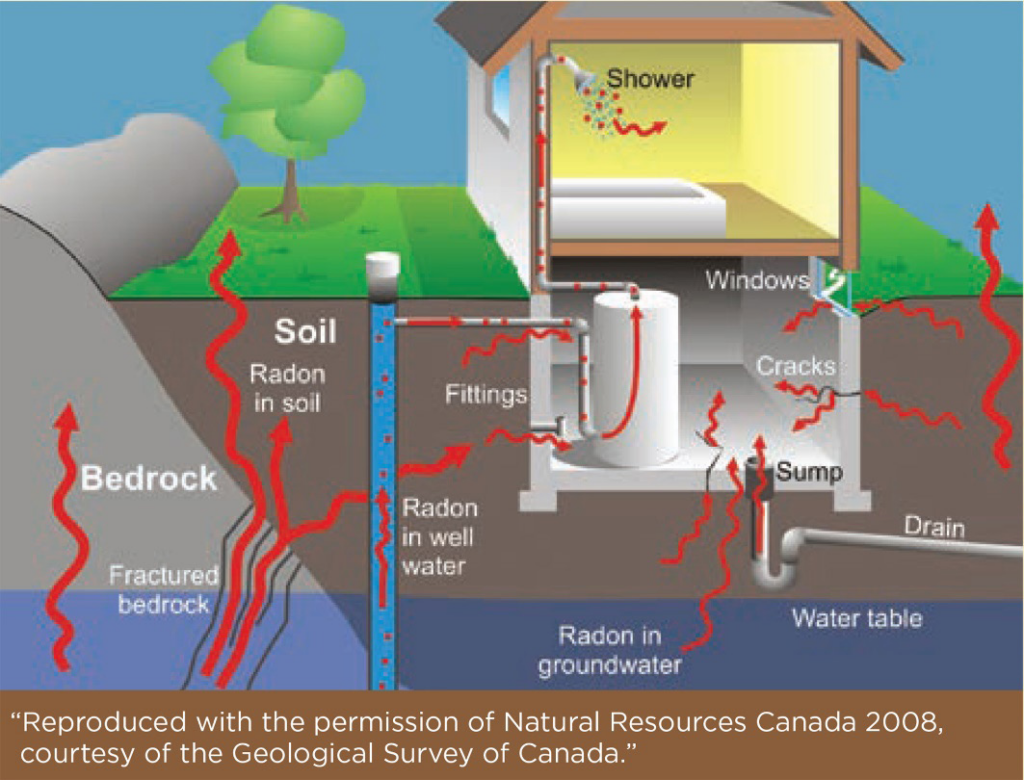
Once inside, radon accumulates — particularly in lower levels of the home. Basements and main floors are where concentrations are typically highest. Upper floors generally have lower radon levels, though air movement within a home can distribute radon throughout.Modern, energy-efficient homes tend to trap radon more effectively than older construction, precisely because they are built to be airtight. Ottawa’s climate also plays a role: homes are sealed tightly for long periods during winter, which reduces the natural air exchange that would otherwise dilute radon.
The Health Risk: Radon and Lung Cancer
Radon is classified as a known cause of cancer by the International Agency for Research on Cancer (IARC). In Canada, it causes an estimated 3,000+ lung cancer deaths per year — approximately 16% of all lung cancer deaths nationally.
The mechanism is important to understand. When radon gas is inhaled, it breaks down into radioactive particles inside the lungs. These particles emit radiation that damages the cells lining the lung tissue. Over years of exposure, this cellular damage can develop into lung cancer.
There are no early warning signs. Radon does not cause irritation, coughing, shortness of breath, or any other acute symptoms — even at elevated concentrations. The damage accumulates invisibly over time.
Risk depends on three factors:
- The concentration of radon in the air you breathe (measured in Bq/m³)
- The length of time you are exposed
- Whether you smoke or have smokedSmokers who are also exposed to elevated radon face a substantially higher lung cancer risk than either factor alone would produce — the two risks combine. But non-smokers are not protected: radon is the number one risk factor for lung cancer among people who have never smoked.The Canadian Cancer Society states clearly that “there are no safe levels of radon exposure” — the goal is always to reduce exposure as low as reasonably achievable.
Radon in Ottawa: Why This City Has Elevated Risk
Ottawa’s geology creates conditions that increase radon risk in many parts of the city. The underlying rock formations in the Ottawa area — including the Billings Formation, the Eastview Member of the Lindsay Formation, and the Bobcaygeon Formation — contain elevated concentrations of uranium relative to the Canadian average. As that uranium decays, radon is released into the soil above it.
The Ottawa-Gatineau metropolitan area as a whole has an estimated prevalence of approximately 1 in 6 homes exceeding Health Canada’s 200 Bq/m³ guideline (Cross-Canada Survey of Radon Concentrations in Homes, 2024). This figure varies significantly by neighbourhood — certain eastern Ottawa communities (Orleans, Blackburn Hamlet, Gloucester) and parts of the southwest (Nepean, Bells Corners) show higher concentrations due to direct geological exposure.
Crucially, radon levels cannot be predicted from street address, neighbourhood, or proximity to a neighbour’s test result. Two adjacent homes can have dramatically different radon levels depending on differences in foundation construction, soil conditions directly beneath the building, and how the home is ventilated. The only reliable way to know your home’s radon level is to test.
How Is Radon Measured?
Radon concentrations are measured in becquerels per cubic metre (Bq/m³) — a unit measuring the rate of radioactive decay in a volume of air.
Health Canada’s guideline: 200 Bq/m³ is the action level for Canadian homes. If your home tests at or above 200 Bq/m³, Health Canada recommends taking action to reduce radon levels.
For context:
- Outdoor air typically contains 5–15 Bq/m³
- Health Canada’s guideline: 200 Bq/m³
- The US EPA’s action level: 148 Bq/m³
- The World Health Organization’s reference level: 100–300 Bq/m³ (reference point)The Canadian Cancer Society notes that even below 200 Bq/m³, reducing radon levels to as low as reasonably achievable is recommended — there is no threshold at which radon becomes safe.
What Can You Do About Radon?
The good news about radon is straightforward: it is both measurable and fixable.
Step 1: Test The first step is a radon test. Testing is the only way to know whether your home has a radon problem. A long-term test (minimum 91 days, ideally conducted during the heating season from October to March) provides the most accurate measurement of your annual average exposure. Digital radon monitors can give you readings from the first day while also building toward a reliable long-term average.
Step 2: Act on the results If your home tests above 200 Bq/m³, Ottawa Public Health recommends mitigation within one year (for levels above 600 Bq/m³) or within two years (for levels between 200 and 600 Bq/m³). These are outside limits — acting sooner is always the better choice.
Step 3: Mitigate The most effective method for reducing indoor radon levels is Active Soil Depressurization (ASD) — a system that draws radon-laden soil gas from beneath your foundation and exhausts it safely outdoors before it can enter your home. ASD systems can reduce indoor radon concentrations by approximately 90% or more and are typically installed in a single day.
For more detail on how testing works, see How to Test for Radon in Your Ottawa Home. For a full explanation of how ASD works and what to expect during installation, see Radon Mitigation in Ottawa.
FAQ
Q: Is radon common in Ottawa? A: Yes. Approximately 1 in 6 homes in the Ottawa-Gatineau area exceed Health Canada’s 200 Bq/m³ guideline (Cross-Canada Survey of Radon Concentrations in Homes, 2024). Ottawa’s underlying geology — including uranium-bearing rock formations — elevates radon risk in many parts of the city, particularly in eastern Ottawa and parts of Nepean and Bells Corners.
Q: Do Ontario houses have radon? A: Radon is present at some level in every building in Canada. Whether the level is high enough to be a health concern depends on the specific conditions of each home — foundation type, local geology, and how the home is ventilated. Ontario as a whole has many areas with elevated radon, and the Ottawa region in particular has geological risk factors that make testing a priority.
Q: Can I tell if I have radon without testing? A: No. Radon is completely invisible, odourless, and tasteless. It causes no physical symptoms even at elevated concentrations. The only way to know whether your home has a radon problem is to test.
Q: Is my newer home safer from radon? A: Not necessarily. Newer homes built to the Ontario Building Code include certain radon-resistant features (soil gas barriers, HRV systems), but these measures reduce, rather than eliminate, radon risk. The airtight construction common in modern homes can actually allow radon to accumulate faster if it enters. Testing is still recommended for newer homes.
Q: My basement tests high — is the rest of my home safe? A: Radon typically concentrates in lower levels of a home, but it can migrate to upper floors through air movement and stairwells. If your basement tests high, it is reasonable to assume radon is present throughout the home at varying concentrations. A proper ASD mitigation system addresses the source, reducing radon throughout the building.
Q: I don’t spend much time in my basement — am I at risk? A: Time spent in a high-radon basement does contribute to exposure, but radon can spread through the home. Testing should be conducted in the area of the home where you spend the most time — typically the main living floor. If your most-occupied room tests above 200 Bq/m³, action is warranted regardless of how much time you spend in the basement.
Q: What’s the difference between radon testing and radon mitigation? A: Testing measures the radon concentration in your home. Mitigation is the installation of a system to reduce that concentration. Testing always comes first — it tells you whether you have a problem and how severe it is. If results are above 200 Bq/m³, mitigation (typically ASD) is the recommended solution.
Q: How quickly does radon cause health problems? A: Radon’s health effects develop slowly over years of cumulative exposure — there are no acute symptoms, even at high concentrations. The lung cancer risk from radon reflects long-term exposure, which is why testing and acting on elevated results is important even if you feel entirely healthy.
Know Your Home’s Actual Radon Level
Radon is invisible, it is present at some level in every Ottawa home, and it is the leading environmental cause of lung cancer in Canada. The reason it remains an underappreciated risk is simple: you cannot detect it without a test. But it is also one of the most straightforward home hazards to address — test first, then, if results are elevated, install an ASD system and verify that it is working.
Ottawa Radon Expert is a trusted local team helping Ottawa homeowners understand and address their radon risk. We provide professional radon testing and Active Soil Depressurization installation, with a post-mitigation warranty on every job.
Contact Ottawa Radon Expert today to take the first step toward knowing what’s in your home’s air.
Internal links: How to test for radon in Ottawa | Radon levels in Ottawa by neighbourhood | Radon mitigation in Ottawa
Sources
- What is Radon? — Canadian National Radon Proficiency Program (C-NRPP)
- Radon — Canadian Cancer Society
- Radon in Your Home — Ottawa Public Health, 2024
- Cross-Canada Survey of Radon Concentrations in Homes — Health Canada / Cross-Canada Radon Survey, 2024
- Radon — Health Canada
- CAN/CGSB-149.12-2024 — Radon Mitigation in Existing Buildings — Canadian General Standards Board, September 2024