
October 9, 2025
How to Test for Radon in Your Ottawa Home: A Complete Guide
Not sure how to test for radon in your Ottawa home? Learn which testing options exist, where to place your detector, how to read the results, and what to do next.
Radon has no smell, no colour, and no taste — the only way to know whether your home has a problem is to test for it. Fortunately, testing has never been more accessible. This guide walks Ottawa homeowners through every option available today: from traditional lab-analyzed test kits to modern smart sensors that connect to your phone, and what to do once you have your results.
Why Testing Is the Only Option
No visual inspection, no smell test, and no general neighbourhood data can tell you the radon level inside your specific home. Two houses on the same street can have vastly different concentrations depending on foundation type, soil composition beneath the slab, ventilation, and construction details.
Ottawa Public Health is clear: the only way to know if you are being exposed to radon gas is to test for it. Until you have a test result in hand, you are simply guessing.
Three Ways to Test Your Home
Option 1: Passive Test Kit (Mail to Lab)
The traditional approach uses a passive detector — a small device you place in your home for a set period, then mail to a laboratory for analysis. The lab returns a report with your radon concentration in Bq/m³. These kits are widely available at hardware and home improvement stores.
Simple and reliable, they are a good choice if you want a one-time snapshot with no ongoing maintenance.
Option 2: Electronic Smart Monitor
Consumer-grade electronic radon monitors have become increasingly popular — and for good reason. These devices connect to a smartphone app via Bluetooth or WiFi, displaying your radon levels in real time on your phone or on the device’s built-in screen.
Unlike passive kits, smart monitors give you a continuous picture of your home’s radon: you can see how levels fluctuate through the day, across seasons, and respond to changes like opening windows or running your ventilation system. Many Ottawa homeowners find this transparency reassuring — or eye-opening.
One important note when choosing a device: Not all consumer sensors on the market are reliable. Health Canada has flagged a number of inexpensive imported sensors as performing poorly in testing. Look for monitors that have been independently evaluated by the Canadian National Radon Proficiency Program (C-NRPP), which maintains a list of consumer devices that have passed its accuracy standards. Checking the C-NRPP website before purchasing is the simplest way to ensure you are getting a trustworthy reading.
Option 3: Professional Testing
A professional radon testing service uses calibrated equipment and follows Health Canada’s recommended protocols for placement and duration. Professionals can also interpret results near the action level and advise on whether a follow-up long-term test is warranted before committing to mitigation.
How Long Should You Test?
This is the most important thing to understand about any radon test — passive kit or smart monitor. Radon concentrations fluctuate throughout the day and across seasons. A reading taken over a couple of days may look very different from a reading taken two weeks later.
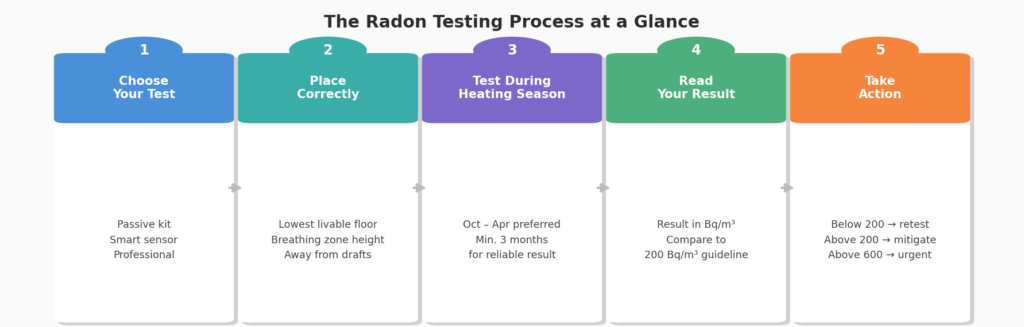
Health Canada recommends a minimum testing period of three months to capture enough variation for a reliable annual average. This applies to both passive kits and electronic monitors — a smart sensor that has only been running for two weeks can show you a real-time reading, but that number alone isn’t a sufficient basis for deciding whether to mitigate.
Think of it this way: a smart monitor gives you continuous, visible data from day one. But the longer it runs, the more representative and trustworthy your average becomes. The three-month minimum exists to protect you from acting — or not acting — on a reading that happens to have been taken during an unusually high or low period.
Best time to test: during the heating season. In Ottawa, this typically runs from October through April. During these months, homes are sealed, ventilation is reduced, and radon accumulates to its highest indoor concentrations. A heating-season test gives you the most conservative — and most informative — picture of your typical exposure.
Where to Place Your Detector
Placement is just as important as duration, regardless of which device type you use:
Floor: Place the test device on the lowest livable floor — typically the basement if it is used regularly, or the ground floor if the basement is unfinished and unoccupied. Radon enters from the ground and concentrates in lower levels first.
Room: Choose a room where you or your family spend at least 4 hours per day — a bedroom, living room, or home office is ideal. Avoid bathrooms, kitchens, laundry rooms, and storage areas.
Height: Place the device in the breathing zone — on a shelf or table, approximately 50 cm to 1.5 m above the floor.
Away from disturbances: Keep the detector away from drafts, windows, exterior doors, and heating vents, which can artificially dilute the reading. Do not place it in a closed cabinet or drawer.
Understanding Your Results
Your test result will be expressed in Becquerels per cubic metre (Bq/m³). Here is how to interpret what you receive:
| Radon Level | What It Means | Recommended Action |
| Below 100 Bq/m³ | Low — no immediate action required | Retest within 5 years or after major renovation |
| 100–200 Bq/m³ | Moderate — below action level | Consider retesting in 1–2 years to confirm |
| Above 200 Bq/m³ | Above Health Canada’s guideline | Take action to mitigate |
| 200–600 Bq/m³ | Elevated | Remediate within two years |
| Above 600 Bq/m³ | Significantly elevated | Remediate within one year |
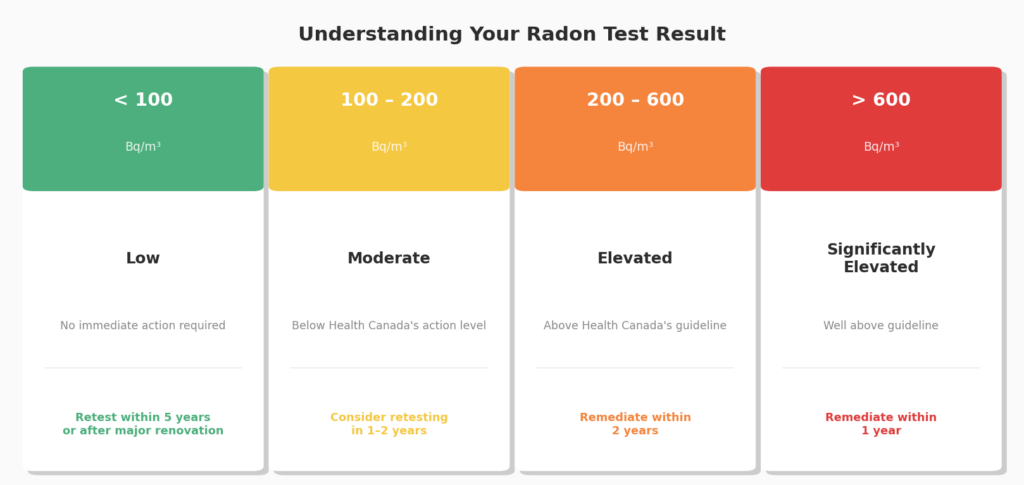
Health Canada’s guideline for indoor radon in homes is 200 Bq/m³. If your result exceeds this level, Ottawa Public Health recommends consulting a radon professional and developing a remediation plan.
Even results below 200 Bq/m³ are worth taking seriously. The Canadian Cancer Society notes there is no level of radon exposure that is entirely without risk, and reducing levels to as low as reasonably achievable is always recommended.
After You Get Your Results
If your result is below 200 Bq/m³: No immediate action is required, but retest within five years, or sooner if you make renovations that affect your foundation, ventilation, or floor plan.
If your result is above 200 Bq/m³: The next step is mitigation. The most effective solution is Active Soil Depressurization (ASD) — a system that redirects radon from beneath your foundation out of the building before it can enter. Most Ottawa homes can be mitigated within a single day. Once a mitigation system is installed, a short-term post-mitigation test (minimum 48 hours) should confirm the system is working effectively.
If your result is above 600 Bq/m³: Ottawa Public Health recommends remediating within one year.
FAQ
Q: Is it worth doing a radon test? A: Yes — especially in Ottawa, where radon levels vary significantly across the city and a significant proportion of homes can have elevated levels. Testing is the only way to know your actual exposure, and it is the essential first step before any mitigation decision.
Q: Do smart radon monitors give faster results than passive test kits? A: Smart monitors display readings continuously from day one, so you can see your radon levels immediately. However, a reliable annual average — which is what you need to make a sound mitigation decision — still requires running any device for at least three months. Think of early readings as indicative, not conclusive.
Q: Can I test in summer? A: You can, but heating-season testing (roughly October to April in Ottawa) is preferred. Sealed homes in winter accumulate radon to their highest concentrations, giving you the most accurate and conservative picture of typical annual exposure.
Q: How often should I retest? A: Health Canada recommends retesting at least every five years, or after any major renovation that affects the foundation, basement, or ventilation system — whichever comes first.
Q: What should I look for in a consumer radon monitor? A: Look for devices that have been independently evaluated by the Canadian National Radon Proficiency Program (C-NRPP). A number of inexpensive imported sensors have been flagged by Health Canada for poor performance. Sticking to C-NRPP-recognized brands gives you confidence that the readings are accurate.
Q: What if my short-term real estate test showed high radon? A: A result above 200 Bq/m³ on a short-term test is worth taking seriously, but short-term readings can vary considerably from a home’s true annual average. Follow up with a longer-term test to get a reliable baseline before making mitigation decisions.
Ready to Know What’s in Your Air?
Ottawa Radon Expert helps Ottawa homeowners understand and address their radon risk. Whether you need guidance interpreting a test result or want a professional assessment of your home, our experienced local team is ready to help — with a post-mitigation warranty on every job we complete.
Contact Ottawa Radon Expert today for a professional evaluation of your home.
Sources
- Steps to Reduce Radon — Canadian National Radon Proficiency Program (C-NRPP)
- Consumer-Grade Electronic Radon Monitors — Canadian National Radon Proficiency Program (C-NRPP)
- Radon in Your Home — Ottawa Public Health, 2024
- Radon — Health Canada
- Testing Your Home for Radon — Health Canada
- Using an Electronic Radon Monitor as a Long-Term Detector — Health Canada
- Cross-Canada Survey of Radon Concentrations in Homes — Health Canada / Cross-Canada Radon Survey, 2024